
Lead Attribution for Long Sales Cycles
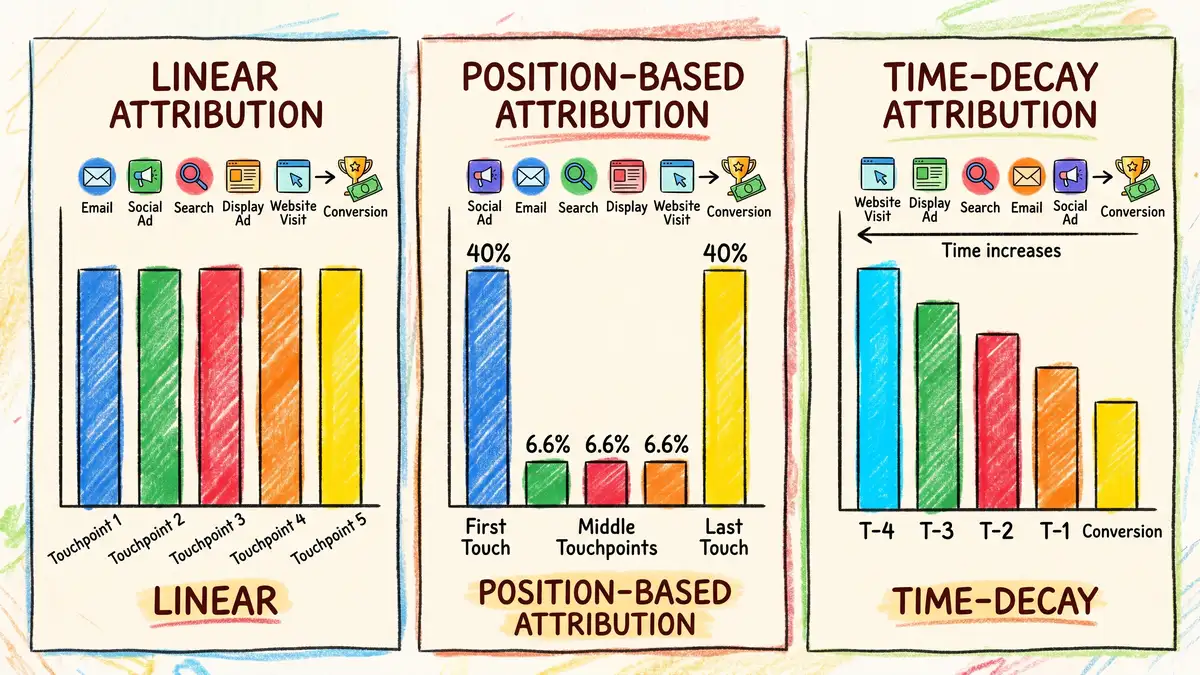
Lead attribution for long sales cycles requires preserving source context across sessions, defining CRM stages consistently, and reporting several models with their limitations. No single touch deserves automatic credit for a decision involving research, referrals, sales conversations, and multiple stakeholders.
Build attribution with analytics and reporting and digital marketing, not as an isolated dashboard.
Map the real buying journey
Document discovery, return visits, content use, form or call, qualification, meetings, proposal, negotiation, and close. Note common offline and cross-device steps. Identify which stages the business can observe reliably.
Define CRM stages
Create operational definitions for new, valid, qualified, opportunity, won, lost, and recycled records. Train teams and audit usage. Attribution cannot repair inconsistent sales data.
Capture original and latest source
Preserve first-known source, most recent source, campaign fields, landing page, and appropriate click identifiers. Do not overwrite original data on every visit. Keep raw values and a documented channel classification.
Resolve identity carefully
Use consented first-party identifiers and CRM records where lawful. Avoid invasive fingerprinting or unnecessary personal data. Acknowledge that anonymous research and shared devices create gaps.
Connect offline outcomes
Return qualified stages or revenue to advertising systems only when identifiers, privacy, value logic, and deduplication are sound. Separate expected pipeline value from confirmed revenue.
Compare attribution views
First-touch shows discovery, last-touch shows the final measurable entry, and multi-touch models distribute credit. Compare models rather than declaring one objective truth. Explain windows and missing channels.
Include self-reported attribution
An optional “how did you hear about us?” question can reveal referrals, events, communities, and AI research missed by technical tracking. Keep responses separate from observed source data; both are useful but imperfect.
Connect content to progression
Review whether buyers use service pages, comparisons, case evidence, or guidance before sales progression. Link journeys through services, the portfolio, and relevant SEO resources.
Build cohort and lag reports
Group leads by creation period and follow outcomes through enough time for the sales cycle. Recent cohorts will look incomplete. Report median or distribution carefully when sample sizes and data quality permit, without inventing precision.
Govern changes
Document field definitions, channel rules, model settings, lookback windows, consent behavior, and releases. Annotate CRM migrations and campaign changes. Restrict access and retain only necessary data.
What does long-cycle attribution cost?
Cost depends on CRM quality, domains, channels, offline steps, identity, consent, data warehouse needs, and stakeholder reporting. A simple professional-services funnel differs from enterprise sales involving several systems.
Checklist
Map online and offline buying steps.
Standardize CRM stages and reasons.
Preserve original and latest sources.
Use privacy-aware identity rules.
Deduplicate leads and outcomes.
Compare several attribution models.
Report cohorts after sufficient lag.
Document uncertainty and governance.
Frequently asked questions
Which attribution model is best?
No model is universally best. Use views suited to discovery, conversion, and budget decisions, with limitations stated.
Why does recent marketing look weak?
Long sales cycles mean recent cohorts have not had time to qualify or close.
Can GA4 replace a CRM?
No. Analytics describes site behavior; the CRM manages leads, stages, and sales outcomes.
Should revenue be sent to ad platforms?
Only with accurate values, identifiers, consent, security, and deduplication.
Is self-reported source reliable?
It is incomplete and influenced by memory, but it can reveal channels technical tracking misses.
How often should rules be audited?
After tool or process changes and on a recurring schedule aligned with business risk.
Conclusion
Long-cycle attribution is a governed evidence system. Preserve source context, maintain CRM discipline, compare models, and wait for outcomes. Honest uncertainty is more useful than false precision.
Related Resources
For additional information and practical guidance, explore these related resources:
Learn more about pool glass fencing in Dubai
Read our privacy and safety guidelines
Explore our beginner's guide
Visit the official resource [wall mirror installation]
Comments
Comments appear after admin approval.