
Optimize Content for Google AI Overviews
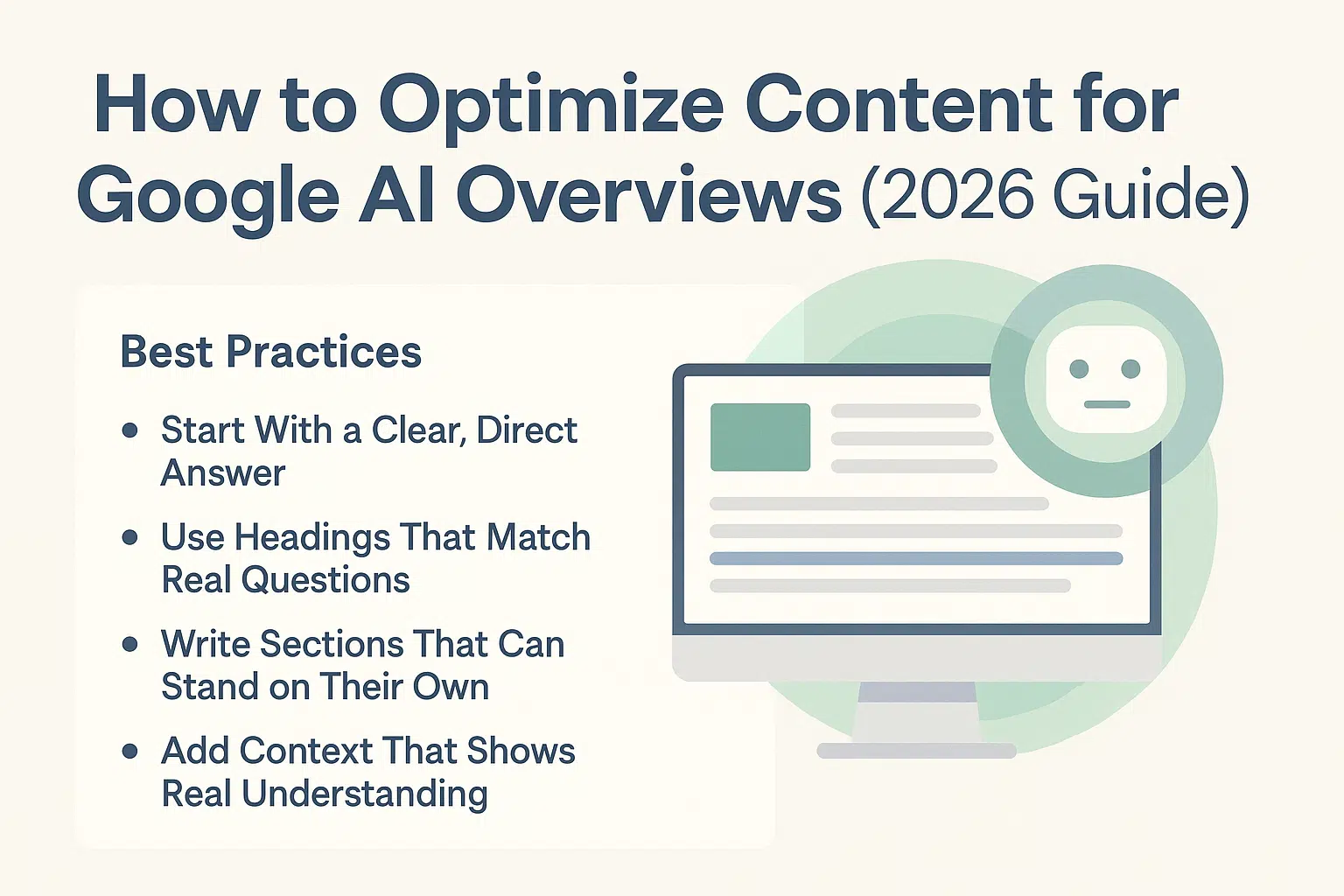
To optimize content for Google AI Overviews, publish the clearest useful answer you can support, make its context unambiguous, and keep the page technically accessible. There is no special tag that guarantees inclusion. Strong fundamentals—helpful content, crawlability, accurate entities, logical structure, and trustworthy evidence—remain the practical foundation.
This guide focuses on sustainable improvements rather than promises of placement. It complements SEO services and the free website audit for teams reviewing both content and technical delivery.
Answer the main question early
Open with a direct response that matches the page’s actual scope. Define the subject, state the recommended approach, and name any important conditions. Readers should not need to cross a long introduction before learning what the page will help them do.
A direct answer is not the same as a shallow answer. Follow it with the reasoning, steps, alternatives, and evidence needed for an informed decision. Use plain language and define specialized terms when they first appear.
Cover the task, not every related keyword
Map the questions a person needs to resolve: what the concept means, when it applies, how to implement it, what can go wrong, how alternatives compare, and how success is measured. Keep unrelated intents on separate pages.
This task-focused structure reduces cannibalization and helps systems identify which passage answers which question. Review on-page versus off-page SEO to separate page improvements from external authority work.
Use headings that communicate relationships
Organize the page with one clear H1 and descriptive H2 and H3 headings. A heading should identify the question or decision in the section, not repeat a keyword mechanically. Lists are helpful for sequences and checks; tables are useful for true comparisons; prose is better for nuance.
Keep the answer immediately below the heading. Avoid hiding important text in decorative interactions that may be difficult to access or render.
Make entities and context explicit
Use the full names of organizations, products, locations, standards, and methods when ambiguity is possible. Explain how they relate. A page about a service should clearly identify the provider, audience, service area, process, limitations, and next step.
Structured data can reinforce visible information, but it cannot replace it. Mark up only facts users can verify on the page. Do not invent ratings, prices, authorship, or organizational relationships.
Add original, verifiable value
Generic summaries are easy to reproduce. Useful differentiation may come from a tested workflow, decision criteria, screenshots you own, annotated examples, a transparent methodology, first-party observations, or an expert explanation of tradeoffs.
State what evidence supports a recommendation and distinguish fact from professional judgment. Date-sensitive guidance should be reviewed. Correct outdated information rather than adding a fresh date to unchanged copy.
Build passages that stand on their own
Each major section should identify its subject instead of relying on vague references such as “this” or “it.” Define abbreviations, include necessary conditions, and make conclusions clear. This improves scanning for humans and reduces ambiguity for systems extracting a passage.
Do not turn every paragraph into a rigid answer block. Natural transitions, examples, and caveats remain important. The goal is clarity, not robotic formatting.
Strengthen technical accessibility
Ensure the page returns the correct status, can be crawled, uses a stable canonical URL, renders primary content reliably, and links to supporting pages with ordinary anchors. Avoid accidental noindex directives, blocked assets, broken internal links, and content available only after a fragile interaction.
The guides to accessibility in web development and website performance help align technical quality with real user experience.
Use internal links as evidence paths
Link to the most relevant service, methodology, example, or deeper explanation. Descriptive anchors help readers predict the destination. Three useful links are better than eight forced ones; a long guide may justify more.
For commercial pages, connect information to a credible next step such as analytics and reporting or relevant portfolio work, but do not interrupt every answer with a sales prompt.
Measure outcomes beyond a citation
Track organic landing-page engagement, branded demand, assisted conversions, qualified enquiries, and visits from AI-enabled search or answer tools where referrer data is available. Reporting can be incomplete, so combine analytics with search performance, CRM outcomes, and periodic manual review.
Record the query, location, device, date, and observed feature when doing spot checks. A single screenshot is not a trend.
What does AI Overview optimization cost?
Cost depends on the number of pages, research depth, subject-matter review, technical issues, content gaps, governance, and measurement setup. Improving five high-value guides is different from rebuilding a large knowledge base.
Scope the work around audits, content updates, new content, technical implementation, and ongoing review. No responsible provider can guarantee an AI Overview citation or a fixed traffic outcome.
Practical checklist
State the supported answer near the beginning.
Match one primary intent and its necessary subquestions.
Use descriptive headings and self-contained passages.
Identify entities and relationships clearly.
Add original examples, criteria, or methodology.
Verify crawlability, rendering, canonicals, and links.
Review date-sensitive facts and claims.
Measure qualified business outcomes.
Frequently asked questions
Can a page guarantee inclusion in an AI Overview?
No. Search features select and present information algorithmically. You can improve clarity and eligibility, but you cannot promise selection.
Is special AI schema required?
No universal “AI Overview schema” guarantees inclusion. Use supported structured data that accurately represents visible content.
Should every answer be one sentence?
No. Start directly, then give the explanation, conditions, examples, and limitations the decision requires.
Do FAQs improve AI visibility?
FAQs help when they answer real follow-up questions. Repetitive keyword variations or invented questions add little value.
Should content be written for bots?
Write for people and make meaning explicit. Clear structure benefits readers, accessibility tools, search systems, and language models.
How often should a guide be updated?
Review it when facts, products, interfaces, laws, or recommended practices change, and on a schedule proportionate to the topic’s volatility.
Conclusion
AI Overview optimization is disciplined publishing: answer clearly, support the answer, make context explicit, and deliver the page reliably. The durable advantage is not a trick for one feature; it is a body of content that people can trust and systems can interpret.
Further Reading: For more information, see this [packers and movers in business bay].
Comments
Comments appear after admin approval.