
Headless CMS vs Traditional CMS
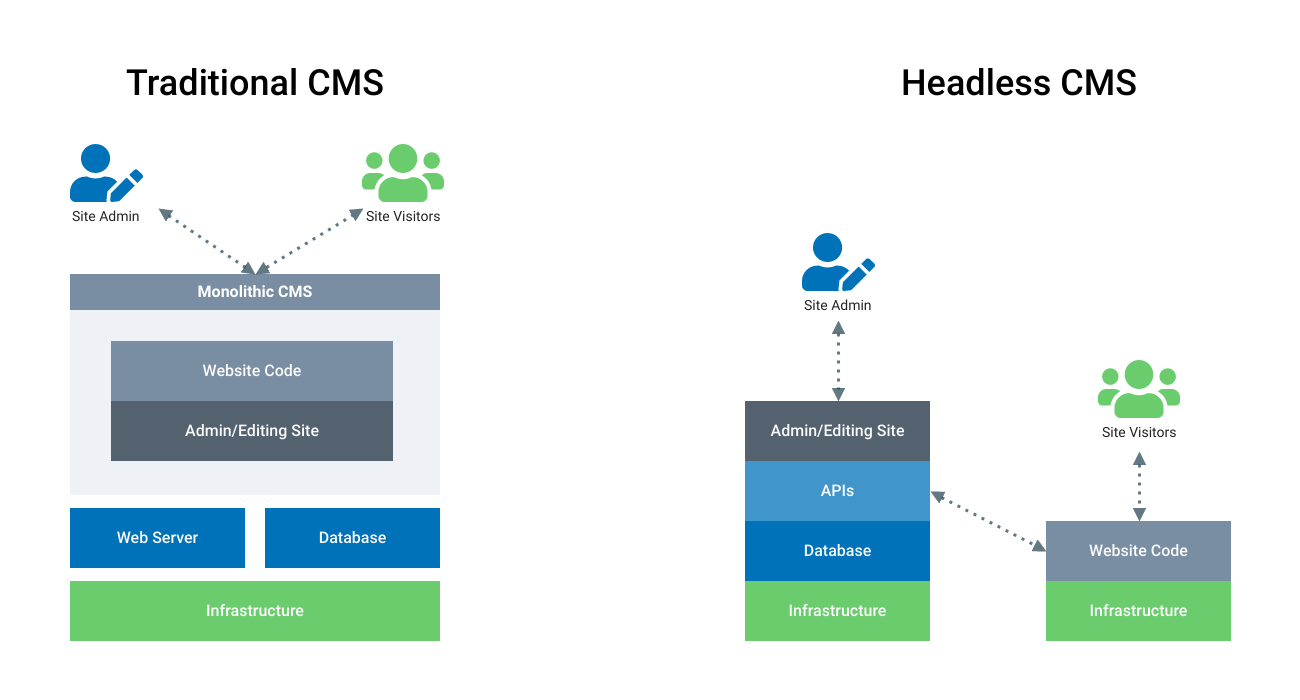
A traditional CMS combines content management and page delivery, while a headless CMS manages content through APIs and leaves presentation to separate applications. Choose based on publishing workflow, channels, integration needs, developer capability, and long-term ownership—not on whether the architecture sounds modern.
Both approaches can support effective web development, web design, and SEO when requirements are implemented deliberately.
How a traditional CMS works
A traditional CMS usually provides an editor, templates, media, plugins, users, and website delivery in one system. Editors can preview and publish pages with fewer separate services.
This integration can reduce initial complexity for content-led websites. Constraints appear when several channels require different presentations or custom application behavior exceeds the platform model.
How a headless CMS works
A headless CMS stores structured content and exposes it through APIs. A web application, mobile app, kiosk, or other channel retrieves and presents that content. Teams choose the front-end technology and deployment model.
This separation can improve reuse and front-end control, but previews, routing, forms, search, redirects, authentication, and analytics require coordinated implementation.
Editor experience
Traditional systems often provide immediate page previews and familiar visual editing. Headless systems may offer structured forms and previews, but the experience depends on integration. Editors can lose page context if the content model is designed only for developers.
Test real publishing tasks: building a landing page, scheduling content, managing translations, replacing media, creating redirects, and approving changes.
Omnichannel content
Headless architecture is useful when the same governed content must support several genuinely different channels. Structure content into reusable fields without stripping away the context each channel needs.
If the organization publishes only a website, omnichannel flexibility may not justify added infrastructure.
Design and development
Headless front ends give engineering teams broad control over components and rendering. Traditional CMS projects can also deliver custom themes and component systems. The difference is where templates run and how content reaches them.
Use accessibility in web development as an acceptance requirement regardless of architecture.
SEO and rendering
Both approaches can deliver crawlable HTML, metadata, canonicals, sitemaps, structured data, redirects, and internal links. Headless teams must ensure the front end implements these fields and renders essential content reliably.
Traditional plugins may simplify administration but still require configuration and QA. The new website SEO checklist applies to both.
Performance and resilience
Headless sites can use static generation, server rendering, edge delivery, and targeted data fetching. Traditional sites can use caching, CDNs, optimized themes, and efficient hosting. Either can become slow through poor queries, oversized media, scripts, or third parties.
Review website performance guidance and plan failure behavior when an API or build process is unavailable.
Security and operations
Headless architecture separates services, which can reduce some exposure while adding APIs, tokens, webhooks, deployment pipelines, and vendor dependencies. Traditional systems concentrate capabilities and require disciplined updates, permissions, and extension review.
Document backups, recovery, access, monitoring, updates, incident ownership, and data export.
Integrations and forms
Map search, CRM, email, payments, personalization, consent, and analytics. In headless systems these may be separate services; in traditional systems they may be plugins or custom modules. Evaluate data flow, ownership, limits, and fallback behavior.
Connect measurement to analytics and reporting before selecting vendors.
Total cost of ownership
Traditional CMS costs may include hosting, themes, plugins, customization, maintenance, and security. Headless costs may include the CMS, front-end hosting, builds, search, preview, developers, monitoring, and additional services.
Compare discovery, design, content modeling, migration, development, integrations, QA, licenses, support, and future changes over the same period. Headless is not automatically cheaper or faster.
Decision checklist
How many distinct publishing channels exist?
What preview and approval workflow do editors need?
How structured and reusable is the content?
Which features and integrations are critical?
What rendering and SEO requirements apply?
Does the team have front-end and API operations capability?
How will outages and vendor changes be handled?
What is the multi-year ownership cost?
Frequently asked questions
Is headless CMS better for SEO?
No. It offers implementation flexibility, but the front end must still deliver all SEO requirements correctly.
Is headless CMS faster?
It can be fast with good architecture. Data fetching, scripts, media, and third parties can still create poor performance.
Can editors preview headless pages?
Yes, when preview is deliberately integrated. Verify the exact workflow before selecting a platform.
Does a small business need headless?
Usually only when its channels, integrations, or product requirements justify the added complexity.
Can a traditional CMS serve an app?
Many provide APIs, but assess data structure, authentication, performance, and long-term support.
How difficult is migration?
Difficulty depends on content structure, volume, media, URLs, workflows, integrations, and quality of existing data.
Conclusion
Choose a traditional CMS when integrated publishing and operational simplicity fit. Choose headless when structured content must power multiple experiences and the team can own the architecture. The best system is the one editors, developers, and the business can maintain together.
Further Reading: For more information, see this [Table Top Glass Delivery in Dubai].
Comments
Comments appear after admin approval.