
Custom Software vs SaaS: Cost and Fit
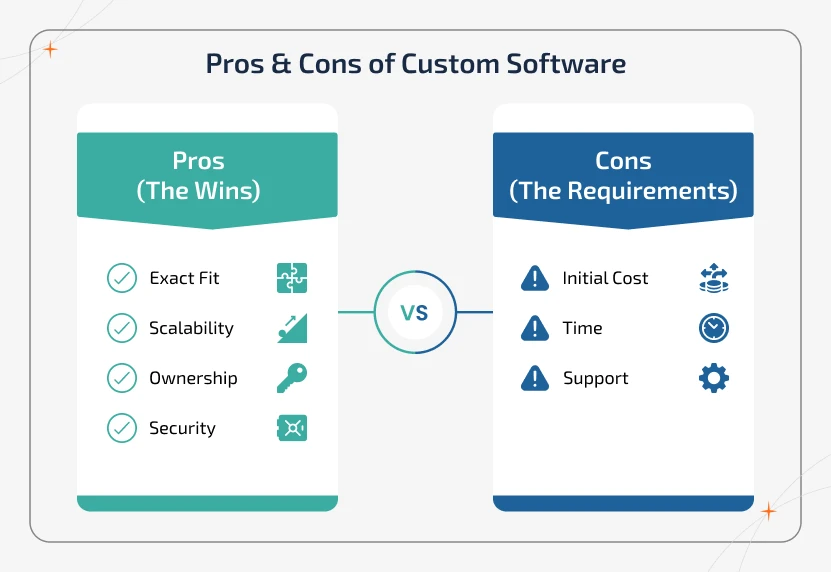
Choose SaaS when a maintained product fits the workflow with acceptable configuration; choose custom software when proprietary processes, integrations, control, or differentiation justify building and operating a system. Compare total ownership cost and risk, not subscription price against build price alone.
Use development services, the portfolio, and analytics to define evidence and delivery expectations.
Document the workflow
Map users, roles, data, decisions, exceptions, integrations, volume, and service levels. Identify which steps create competitive value and which are standard operations.
Evaluate SaaS fit
Test the real workflow in a trial or sandbox. Review configuration, permissions, APIs, reporting, localization, accessibility, support, uptime commitments, export, and roadmap.
Estimate customization pressure
If success requires many workarounds, spreadsheets, duplicated entry, or unsupported extensions, the apparent SaaS simplicity may erode. Distinguish manageable process change from constraints that harm the business.
Evaluate custom software
Custom development can encode exact workflows and integrations, but the organization owns discovery, design, engineering, testing, hosting, security, monitoring, documentation, and evolution.
Review website development considerations for project governance.
Compare integration risk
For each system, examine authentication, limits, webhooks, data direction, error recovery, reconciliation, and vendor ownership. A ready connector may be shallow; a custom integration may require ongoing maintenance.
Compare security and compliance
Review access control, data location, encryption, backups, audit logs, retention, incident response, subcontractors, and contractual obligations. Obtain qualified legal and security review where appropriate.
Plan migration and exit
Test data import, export formats, media, relationships, history, and account ownership. SaaS needs an exit plan; custom software needs source, infrastructure, credentials, documentation, and handover.
Model total cost
SaaS cost includes subscriptions, users, usage, implementation, integrations, training, support, and price-change risk. Custom cost includes discovery, build, infrastructure, operations, updates, security, and future features.
Compare the same time horizon and business volume. Do not invent precision when requirements are uncertain.
Use a staged decision
A prototype, limited SaaS pilot, integration proof, or custom discovery phase can test the largest risk before full commitment. Define success and stop conditions.
What does custom software cost?
A credible estimate requires prioritized requirements, quality standards, integrations, data, security, and support. Universal prices ignore the complexity that makes custom work necessary.
Decision checklist
Which workflows are standard or differentiating?
How well does SaaS fit without workarounds?
Which integrations and data controls are critical?
What security obligations apply?
Can the team operate custom software?
How will data be migrated and exported?
What is the multi-year cost?
Which pilot can test the largest risk?
Frequently asked questions
Is custom software always more expensive?
Not always over the full lifecycle, but it usually requires greater initial and operational responsibility.
Can SaaS be customized?
Often through settings, APIs, and extensions. Confirm supportability and upgrade impact.
Who owns SaaS data?
Contract terms vary. Review ownership, access, export, deletion, and retention before purchase.
Can a prototype become production software?
Sometimes, but prototypes may omit security, scalability, accessibility, and maintainability. Plan the transition explicitly.
What is vendor lock-in?
Dependence that makes switching difficult because of data, workflows, contracts, integrations, or proprietary formats.
When is custom development justified?
When measurable value from fit, control, integration, or differentiation outweighs build and operating costs.
Conclusion
Buy the standard capabilities you do not need to differentiate and build only where control creates justified value. Test fit, model ownership, and preserve an exit path whichever option you choose.
Further Reading: For more information, see this [glass partition installation].
Comments
Comments appear after admin approval.